
SkyNet
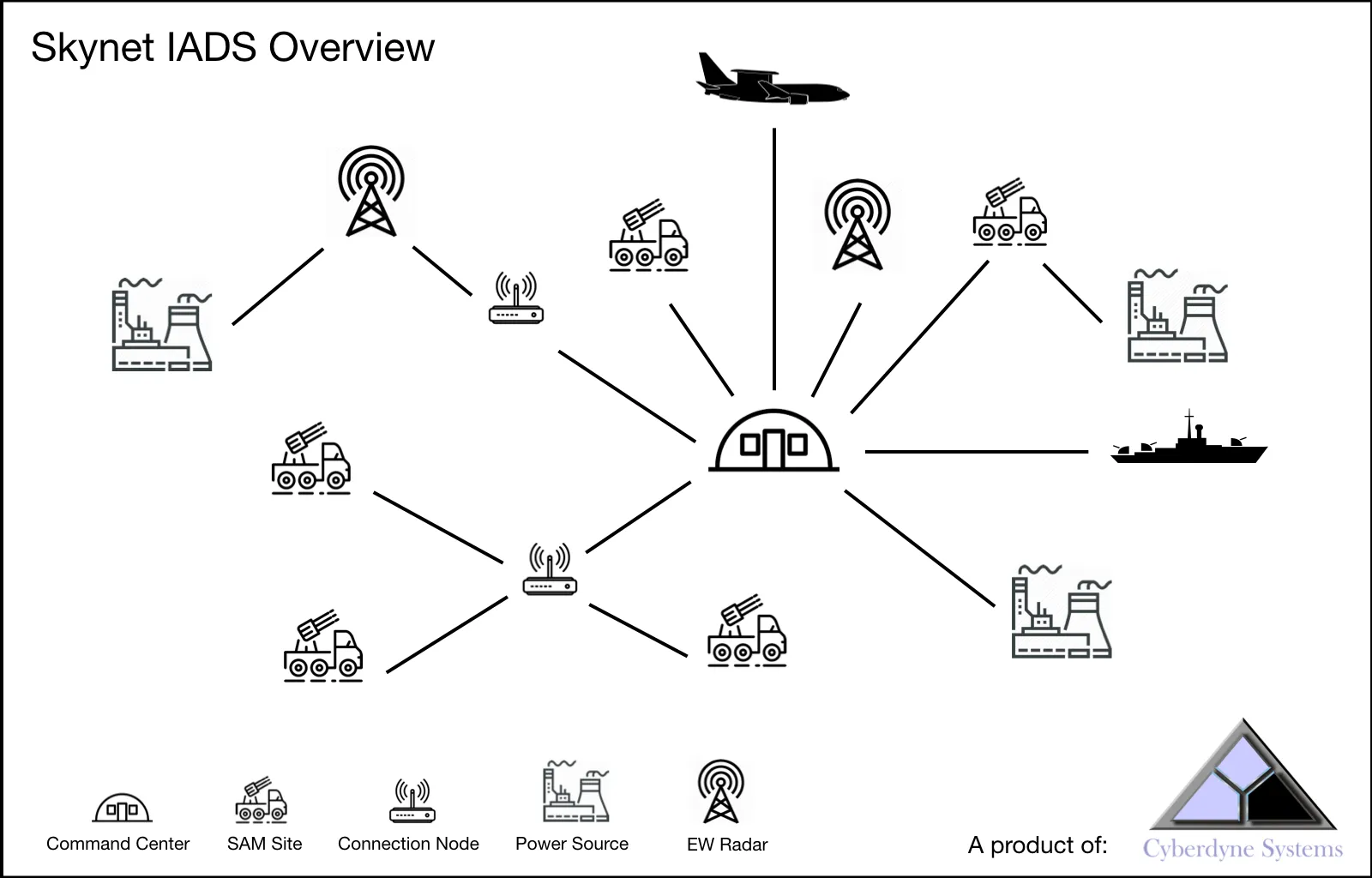
Panther Den features a custom integrated air defense network that governs how enemy radars and SAM sites actually behave, and understanding how it works will make your SEAD and strike planning far more effective.
Enemy SAM sites don’t just sit there with their radars blasting. Early warning radars scan continuously and hand off contacts to the SAM sites tied into the network, and a SAM site will only light up its own radar once a target is actually within its engagement range. That means a site can sit completely dark and undetectable until you’re already inside its envelope, so don’t assume silence means it’s empty — assume it’s waiting.
The whole thing runs through command centers. As long as a command center is alive, the network functions as designed: EW radars feed contacts, SAM sites go live on cue, everything’s coordinated. Kill all the command centers tied to a network and it falls apart — sites left without central coordination fall back to their own local behavior instead of the coordinated one, so taking out command and control is a legitimate way to degrade an entire integrated network rather than clearing it site by site.
Some SAM systems, especially long-range ones, can also act as their own early warning radar, meaning their radar stays on more consistently to feed the network rather than only activating right before engagement. Knocking out a network’s dedicated EW radars can leave nearby SAM sites blind and force them back to their own organic sensors — or dark entirely, depending on how they’re set to behave when isolated. Losing EW coverage or being outside AWACS coverage has the same effect on a site: it goes autonomous.
Power and connectivity matter too. Some sites depend on power sources and connection nodes to stay part of the network; take those out and that emitter drops out of the coordinated picture even if the actual radar and launchers are untouched. This is a real-world SEAD tactic — going after the infrastructure, not just the launchers.
HARM defense is built in and it’s not trivial. If a SAM site or EW radar suspects a HARM is inbound — based on the shot’s speed, flight path, and whether more than one radar picked it up — it can shut down its radar before impact, which will cause a lot of HARM shots to miss by a wide margin as the missile glides toward the last known position instead of a live one. Older systems are much worse at this and can really only react at very close range, so don’t expect a legacy SAM to dodge cleanly, but expect modern ones to. Sites also don’t necessarily go fully dark and blind themselves during a HARM threat if they have dedicated short-range point defense protecting them — as long as the defenders can handle the number of inbound HARMs, the protected radar can keep emitting and let its escorts handle the threat instead.
Jamming is also part of the network’s behavior on the receiving end. A jamming aircraft flying with a strike package can degrade a SAM site’s effectiveness, but that effect weakens the closer the jammer gets to the site itself, and it only works with line of sight. Older systems are more vulnerable to it than newer ones. If you’re running electronic warfare support, staying with the package rather than standing off from a distance will get you a much more realistic and effective result.
Bottom line: treat the enemy air defense picture as a live, reactive network, not a set of static targets. Silence doesn’t mean safety, a dead SAM site’s radar doesn’t mean the network is beaten, and going after command centers, EW radars, and power infrastructure is often more effective than trying to trade shots with every launcher one at a time.
HARM Detection
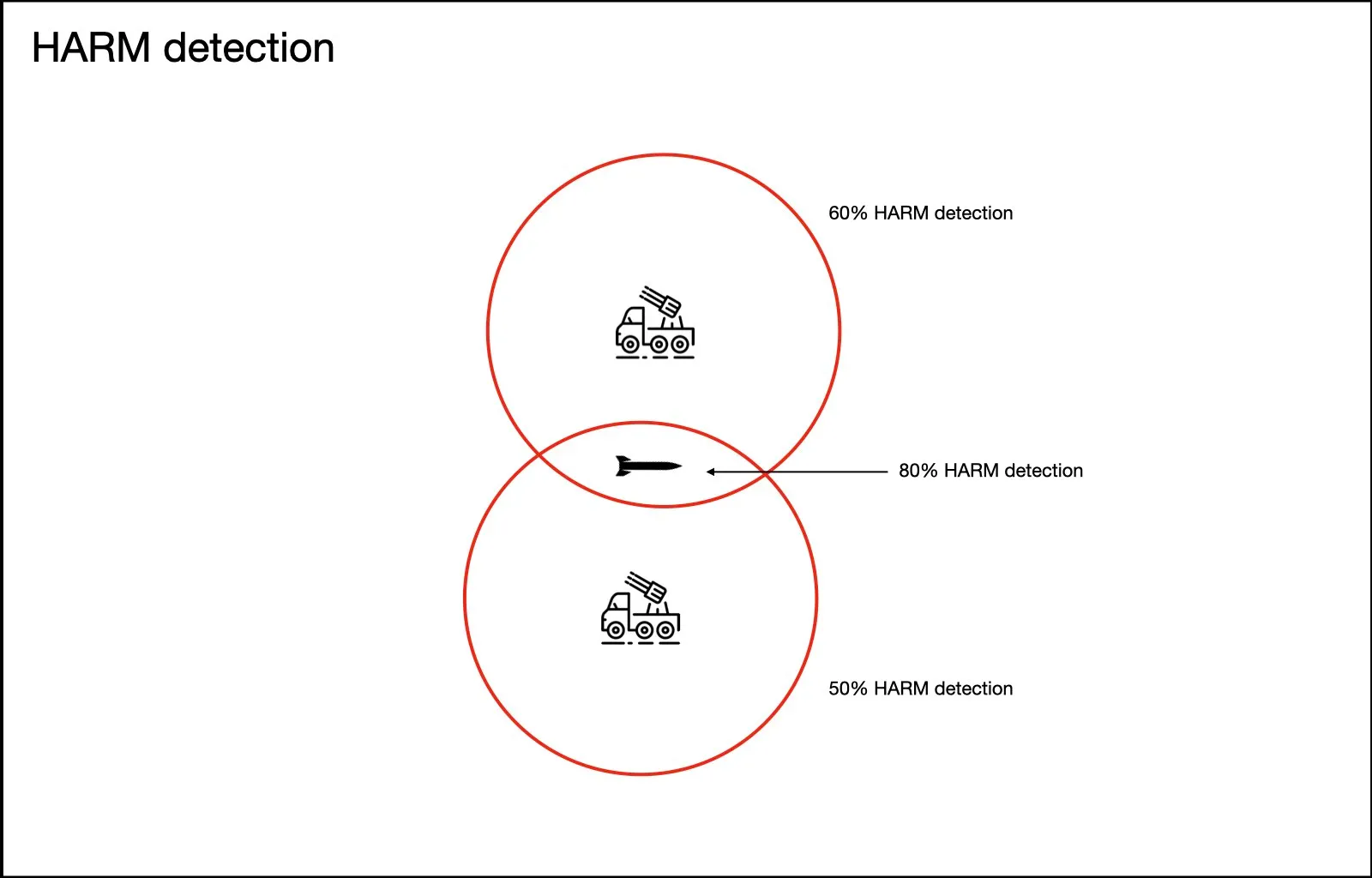
Section titled “HARM Detection”Not every radar reliably sees a HARM coming — detection is a gamble, not a guarantee. Each system has its own chance of noticing an inbound anti-radiation missile, and older systems are worse at it (an SA-2 catches it around 60% of the time, an SA-6 around 50%). The catch is that if more than one radar picks up the same missile, the network becomes far more confident — roughly an 80% chance it correctly flags the shot as a HARM and reacts. In practice, a site might completely miss your shot and eat it, or it might spot it and go dark, and you can’t count on either outcome in advance.
HARM Flight Path Analysis
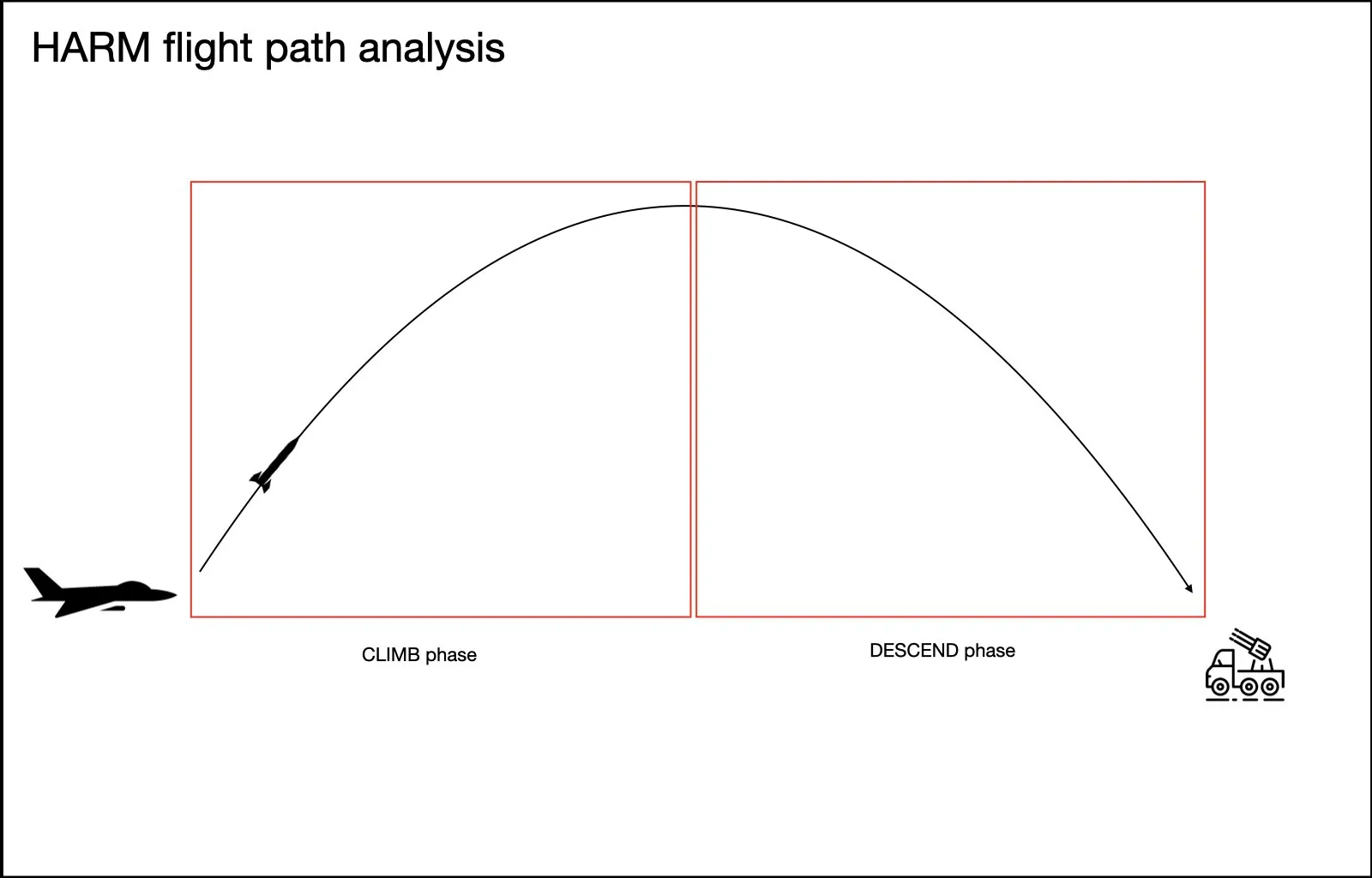
Section titled “HARM Flight Path Analysis”The network doesn’t panic at every fast-moving contact. Before it decides something is actually a HARM, it checks the flight profile: the contact has to be traveling faster than 800 knots and holding a fairly straight course — no more than a couple of course changes. That filters out maneuvering fighters and stops the site from crying wolf every time a fast mover blows through. A clean, fast HARM shot fits this profile and is more likely to be recognized — and defended against — than a missile masked among hard-maneuvering aircraft.
HARM Radar Shutdown
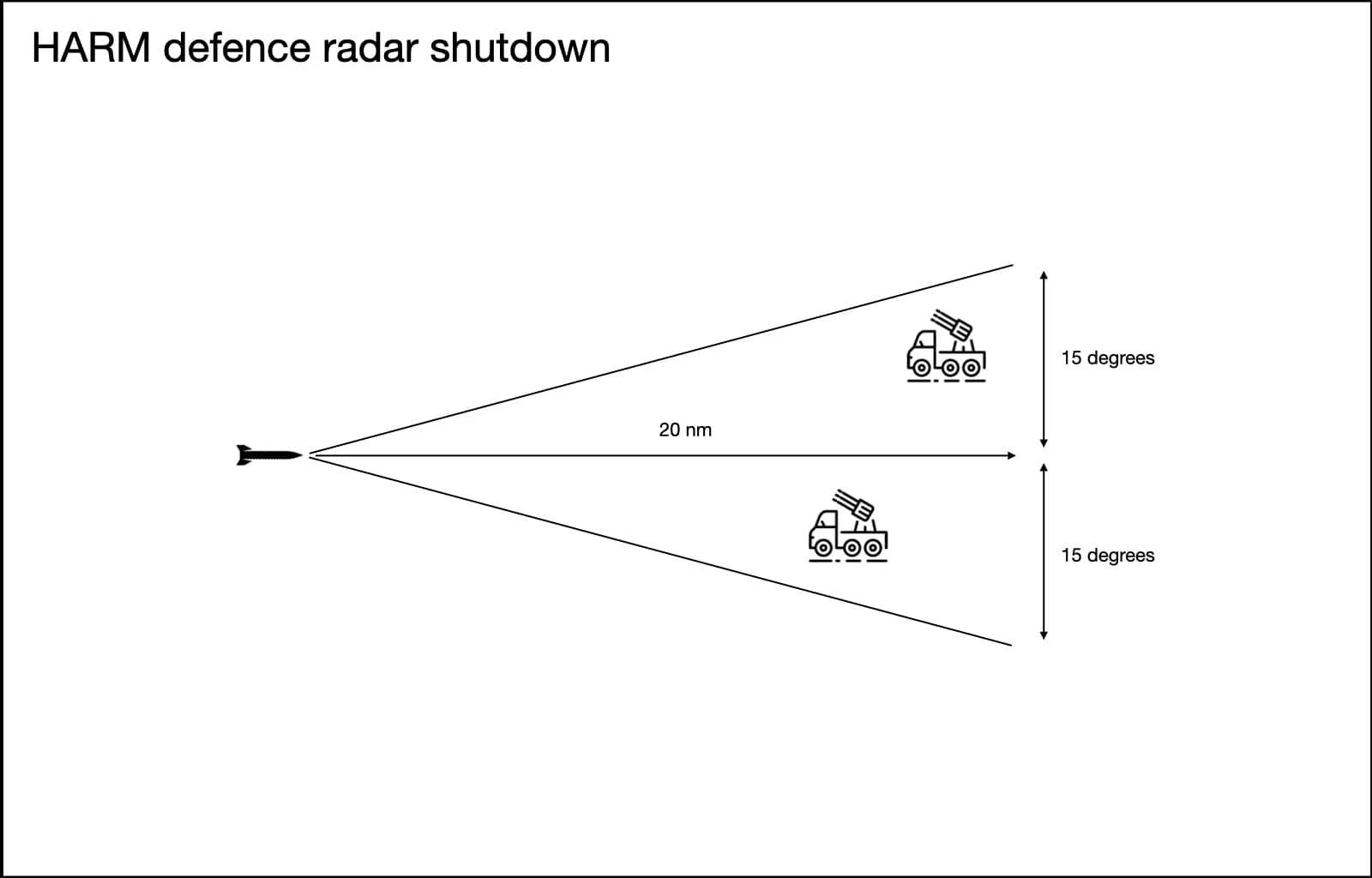
Section titled “HARM Radar Shutdown”Once a site is confident a HARM is inbound, it goes dark to defeat it — but only the radars roughly in the missile’s path. The network shuts down radars within about 15° either side of the HARM’s flight path and up to 20 nautical miles ahead of it, while radars outside that cone keep working. Those radars stay off until the threat passes — up to about 180 seconds after the missile’s expected impact time — then come back online. A HARM can silence a slice of the network, but it’s a timed shutdown and the radar will be back, so cueing a follow-up strike for the moment it re-emerges is how you exploit it.
Point Defence
Section titled “Point Defence”Sites protected by dedicated short-range point defence don’t necessarily have to hide. The protected radar keeps emitting as long as its defenders have enough missiles and launchers to shoot down every inbound HARM — roughly one interceptor per HARM. If it’s overwhelmed — more HARMs inbound than the point defences can handle — the radar gives up and shuts down anyway. The takeaway is that saturating a point-defended site with more HARMs than it can intercept is what forces it dark; a single HARM against a well-defended radar just gets swatted while the radar keeps tracking you.
Electronic Warfare
Section titled “Electronic Warfare”Panther Den’s enemy air defense network includes jamming behavior, and it works the way you’d expect from the real thing.
An EW aircraft flying near a strike package can degrade a SAM site’s ability to react to threats — but the closer you get to the site itself, the weaker that effect becomes, so standing off doesn’t help you as much as you might think. The jammer needs line of sight to the radar to work at all, and older SAM systems are more vulnerable to it than modern ones. Early warning radars can’t be jammed.
Effectiveness isn’t universal — you have to actually be jamming the right frequency band for a given SAM site for it to have any effect. A jammer tuned right for one system might do nothing against another, so know what you’re up against before you commit to a jamming plan rather than assuming “jamming on” covers everything on the map. This is done through support jammer escorts flying with the package, not a self-protection pod on the strikers themselves.
For the most realistic experience, fly with an escort acting as your jammer rather than expecting jamming to work from a distance. The farther you are from the jamming source when you’re near a threat radar, the less protection you’re actually getting — think of it the way an EA-6B Prowler crew would have flown it historically, closing to an effective range before turning the equipment on, not lighting it up from way outside and hoping it covers the whole package.
For how to request and fly jammer support in Panther Den, see Jammer Escort.